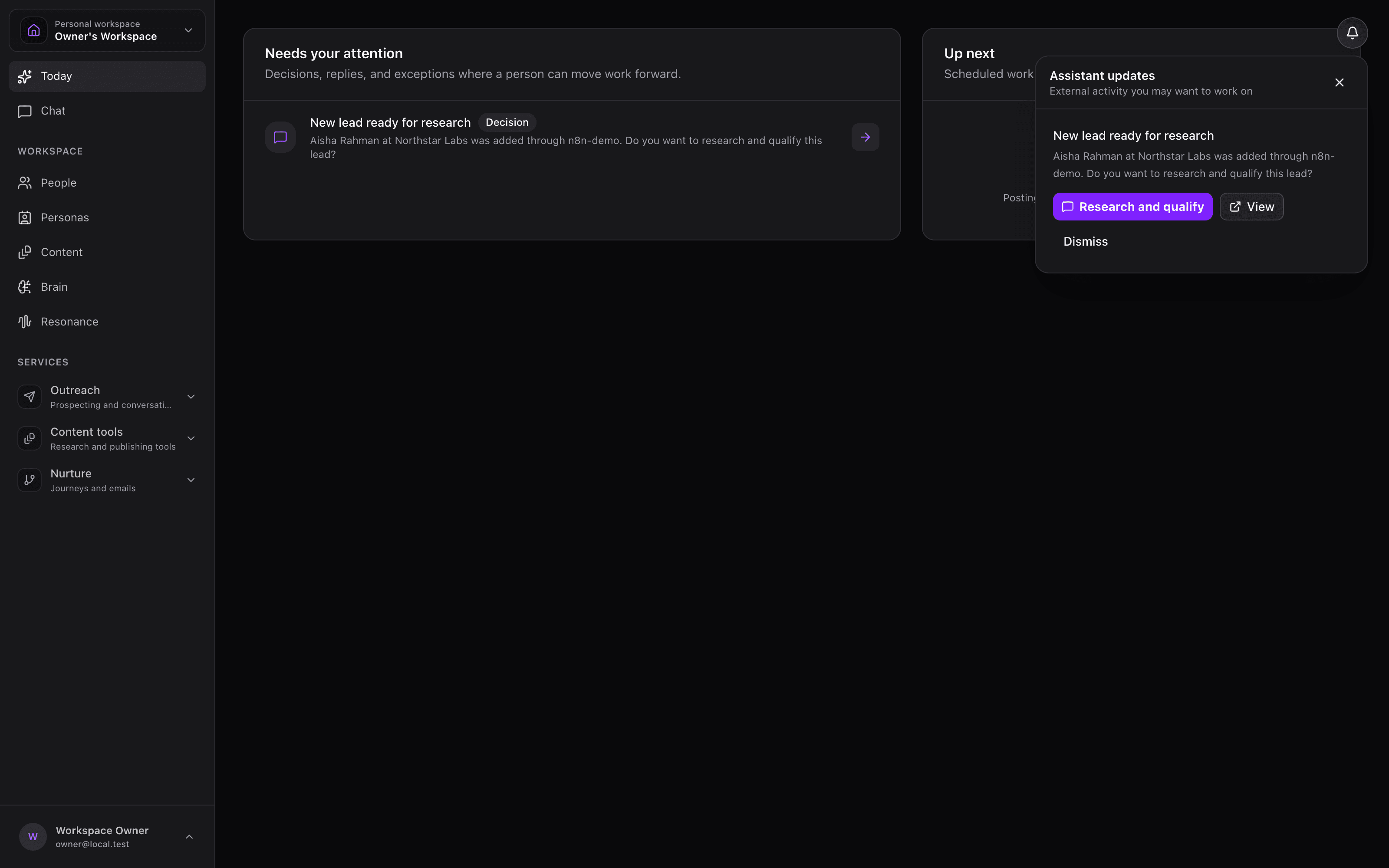
Business systems produce a constant stream of events. A lead changes state, a campaign receives a response, a scheduled workflow finishes, or an external provider reports a result. Treating every event as a notification creates a dashboard that users learn to ignore.
Taicho uses a narrower rule: interrupt a user only when an external event creates a meaningful decision.
An event is not automatically an alert
External systems remain responsible for their own execution. They publish facts about what happened, and Taicho evaluates whether those facts require intelligence work or human attention. Routine success can remain quiet. An event with a decision attached can open a focused path in the workspace.
This distinction prevents the notification surface from becoming an activity log. Activity can still be recorded for audit and context, but attention is reserved for items that deserve a response.
Qualify before interrupting
A useful attention policy considers more than an event name. It can evaluate the workspace, the event category, the affected object, the available context, and whether the user is already looking at the relevant conversation.
For example, an external lead event might deserve attention when it contains enough information to run lead intelligence. The notification can open Chat with the decision and context already attached. A delivery receipt with no exception may need no interruption at all.
Preserve the event durably
Real-time updates are convenient, but they are not a durable system of record. A browser can close, a connection can drop, or a user can be offline. Taicho stores qualified attention so it remains available when the user returns.
The dashboard can update live when the user is present, while the same item survives as unread attention when they are not. This keeps the experience responsive without making correctness depend on an open connection.
Open the decision in context
An actionable notification should answer three questions:
- What happened?
- Why does it matter?
- What can I do next?
Taicho connects the alert to workspace Chat so the user does not have to reconstruct the event manually. The next step can be a fixed intelligence workflow, such as preparing a lead dossier or interpreting an external outcome. The resulting artifact stays linked to the decision that produced it.
Keep delivery outside the boundary
Attention does not mean Taicho takes over the external system. Taicho can recommend the next action and produce the artifact needed for it. An orchestrator or a person still owns the delivery step, provider credentials, retries, and failure handling.
That separation makes alerts more trustworthy. A notification means there is a decision to make, not that an AI agent has already taken an irreversible action in another system.
Design for quiet confidence
The best notification is often no notification. By qualifying external events, preserving important attention, and opening decisions with their context intact, Taicho keeps the dashboard useful even as the surrounding stack becomes more active.
The goal is not to show everything happening in the business. It is to put the right decision in front of the right person at the right time.