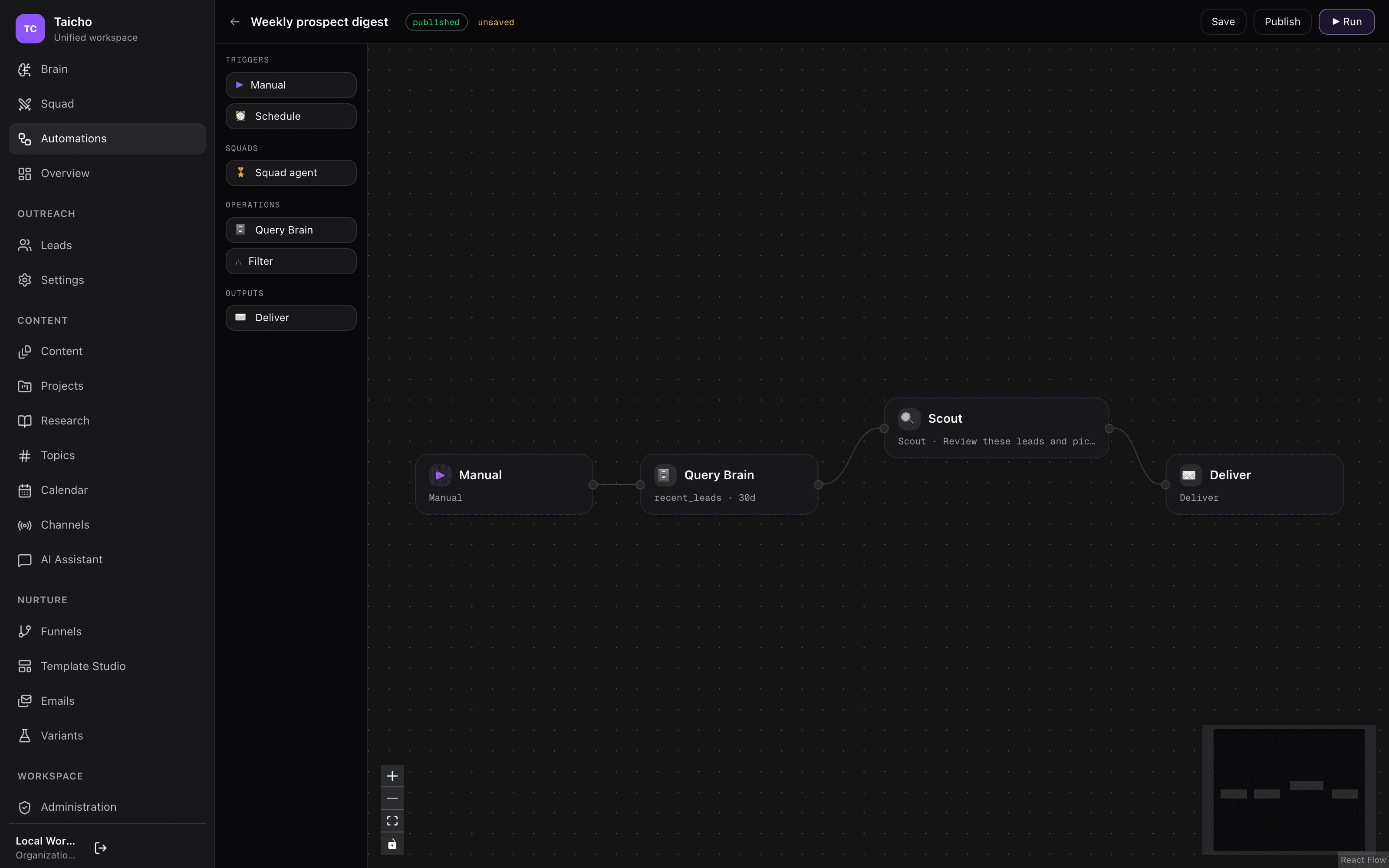
Flexible agent demos are easy to assemble and hard to operate. When every user can improvise a new graph, the expected output, available evidence, and failure behavior can change from one run to the next.
Taicho takes a more explicit approach. The product exposes fixed intelligence workflows with known inputs and structured artifact contracts. Agents and tools can evolve behind the scenes, while the user-facing promise remains stable.
Begin with a canonical workflow
A canonical workflow represents a business job Taicho supports. Current workflow families include research, content, audience, lead, outreach, funnel, and feedback intelligence.
Each workflow defines:
- the decision it supports;
- the context it may use;
- the stages of intelligence work;
- the artifact it must return;
- the policy boundary around the result.
Users select the job they need instead of designing a new internal execution graph.
Keep implementation details replaceable
An agent name, model, or tool is an implementation detail. Taicho can improve those parts without forcing teams to rebuild their process or retrain users around a different interface.
The stable layer is the workflow and its artifact. A lead intelligence run should continue to return a lead dossier even if the research provider changes. A research workflow should continue to preserve sources and evidence even if the internal model is upgraded.
This reduces coupling between product behavior and a fast-changing AI stack.
Make artifacts the contract
A structured artifact gives both people and systems something predictable to inspect. It can require fields, preserve evidence lineage, record uncertainty, and distinguish missing information from a negative conclusion.
That contract also makes quality checks more concrete. A workflow can verify whether required evidence exists, whether the artifact is complete, and whether the result stays within the permitted use of its source material.
Show progress without exposing machinery
Users still need visibility. The dashboard can show the active workflow, current stage, source collection, and artifact preparation without turning the internal agent topology into a configuration surface.
This keeps execution understandable while allowing the implementation to change. Visibility is about the state of the business job, not a live diagram of every internal function call.
Hand off deliberately
Taicho stops at the intelligence boundary. It can produce an outreach message, funnel recommendation, or content package, but it does not silently send or publish the result.
The user or an external orchestration system owns the handoff. That system can apply schedules, approvals, credentials, provider-specific delivery, retries, and failure recovery. Taicho retains the context and can interpret the outcome when it comes back.
Build for repeatability
Fixed workflows do not make the product rigid. They make its promises testable. Teams know what they will receive, developers can evaluate the workflow against a stable contract, and external systems can integrate without parsing an unpredictable chat response.
The result is a cleaner operating model: Taicho thinks, produces a grounded artifact, and explains the decision. The surrounding stack decides when and how that artifact becomes an external action.