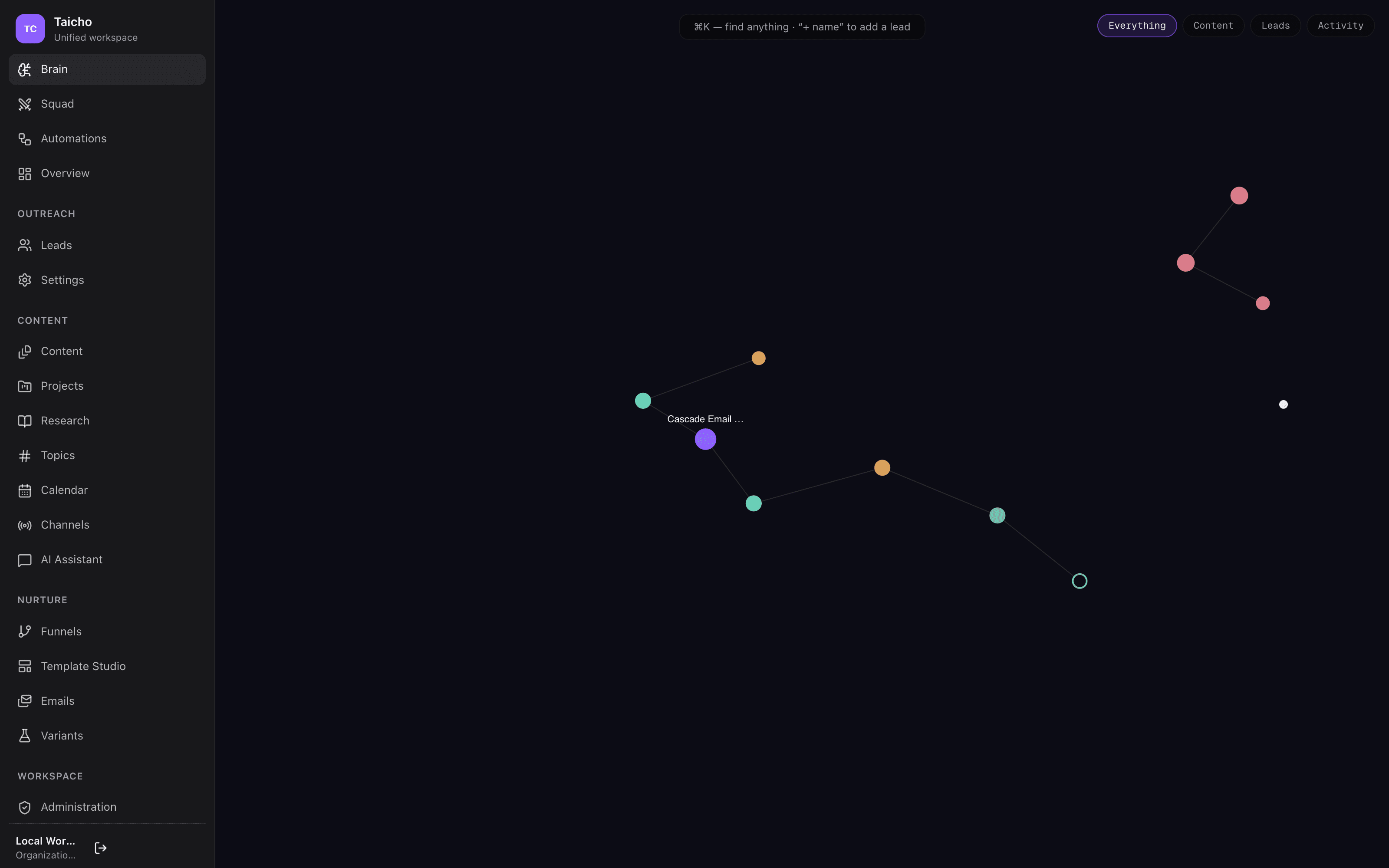
AI output is easier to trust when a team can inspect the knowledge behind it. The Taicho Brain is the workspace view of that knowledge: entities, topics, claims, evidence, sources, assessments, and generated artifacts connected in a graph.
It is not a decorative visualization of model activity. It is a way to navigate business context and verify how a result was grounded.
Organize knowledge around real entities
The Brain can connect the objects a business already reasons about: organizations, people, projects, topics, ideas, prospects, research items, and sources. These entities become stable anchors for new evidence and future workflows.
When a user opens a node, the dashboard can show its neighborhood rather than returning an unstructured list of documents. That makes relationships visible. A prospect can connect to an organization, a qualification, relevant evidence, and a dossier produced from that evidence.
Separate claims from evidence
A source is not automatically a fact, and a model statement is not automatically a verified claim. Taicho keeps those concepts distinct.
Evidence records what a source supports. Claims describe the knowledge accepted from that evidence. Assessments interpret claims for a defined purpose. Artifacts use selected claims and evidence to support a decision.
This structure gives the dashboard a clear answer when a user asks, "Why does Taicho believe this?"
Preserve exact lineage
Lineage records which claims and evidence were used to create an artifact. A research brief, audience evaluation, or lead dossier can therefore retain its grounding after the workflow finishes.
That is more useful than attaching a generic source list to the bottom of a generated document. Reviewers can inspect the specific support for an important conclusion, notice when evidence conflicts, and understand which part of the artifact may need revision.
Respect workspace policy
Knowledge is only reusable when policy allows it. The Brain applies organization boundaries, permitted uses, and sensitivity levels when retrieving context. A workflow should not gain access to restricted material merely because related data exists elsewhere in the graph.
The same policy follows downstream artifacts. A generated result cannot quietly weaken the restrictions inherited from the claims and evidence used to make it.
Search, inspect, and expand
The dashboard supports two complementary ways to explore the Brain. Search helps users find a known entity or topic. The graph view helps them inspect nearby relationships and expand outward from a selected node.
This makes the Brain useful both during focused work and during discovery. A user can find the exact prospect they need, or notice a missing connection that should be researched before the next decision.
Ground future workflows
The value of the Brain compounds when new intelligence workflows reuse accepted, policy-bounded context. Teams do not need to paste the same background into every prompt. Taicho can retrieve relevant knowledge, preserve its provenance, and record how it contributed to the next artifact.
The goal is not memory for its own sake. It is a workspace where evidence can be inspected, decisions can be explained, and useful knowledge can support the next piece of work without losing its source.