Two people in the same workspace rarely need the same interruptions. A founder may want to see a qualified lead event immediately. A researcher may care more about completed research and knowledge gaps. An operator may need exceptions but not routine success.
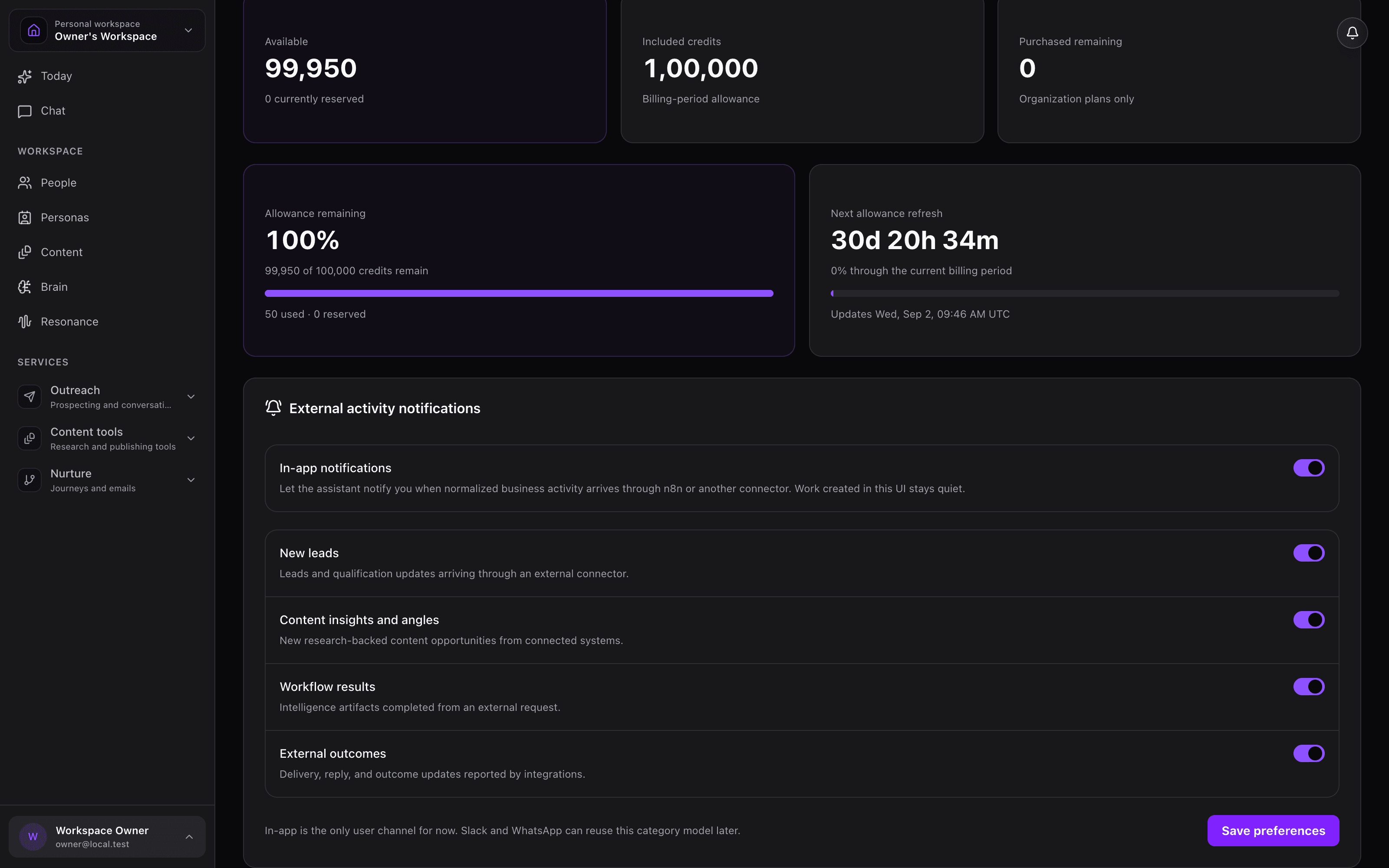
Taicho gives each workspace user control over which categories of external activity create in-app notifications.
Start with a master control
The profile settings include a master in-app notification control. Turning it off stops future external-event alerts for that user without changing organization-wide integrations or deleting existing activity.
This is an important boundary. Notification preferences belong to the recipient. They do not turn the source system on or off, and they do not change what other workspace members receive.
Choose categories that match your role
Below the master control, users can choose the event categories that deserve attention. Categories make the policy understandable without forcing users to configure every provider-specific event name.
A category can represent a meaningful area of work, such as content, outreach, research, or funnel outcomes. The exact external source can change while the user's preference remains stable.
This avoids a common integration problem: notification settings that become obsolete whenever a webhook or automation is renamed.
Apply preferences to future attention
Changing a preference affects future alerts. It does not erase the record of events that already happened or remove artifacts that were already produced. Historical activity remains useful for audit and context.
That behavior keeps settings predictable. A user can quiet a category without rewriting workspace history.
Keep in-app attention separate from delivery
Taicho's controls govern the dashboard's in-app notification surface. They do not configure email delivery, Slack, WhatsApp, schedules, or provider credentials. Those responsibilities stay with the external orchestration system chosen by the organization.
The distinction prevents a personal dashboard preference from accidentally changing a business-critical automation. It also keeps sensitive credentials out of the intelligence workspace.
Pair notification policy with qualified events
Preference controls work best when the platform already filters routine noise. An enabled category does not need to produce an alert for every event. Taicho can still determine whether a specific event creates a decision that requires attention.
The resulting policy has two layers:
- The product qualifies whether an event is meaningful.
- The user decides whether that category should interrupt them.
Both conditions must be satisfied before a new in-app alert appears.
Build a dashboard people can trust
Notification settings are a small feature with a large effect on daily use. When users understand why they were interrupted and can tune the categories they receive, attention becomes a reliable product surface instead of background noise.
Taicho's approach is deliberately limited: personal controls, durable activity, and explicit decisions. The external stack continues to own delivery. The workspace remains focused on the intelligence that helps a person decide what should happen next.