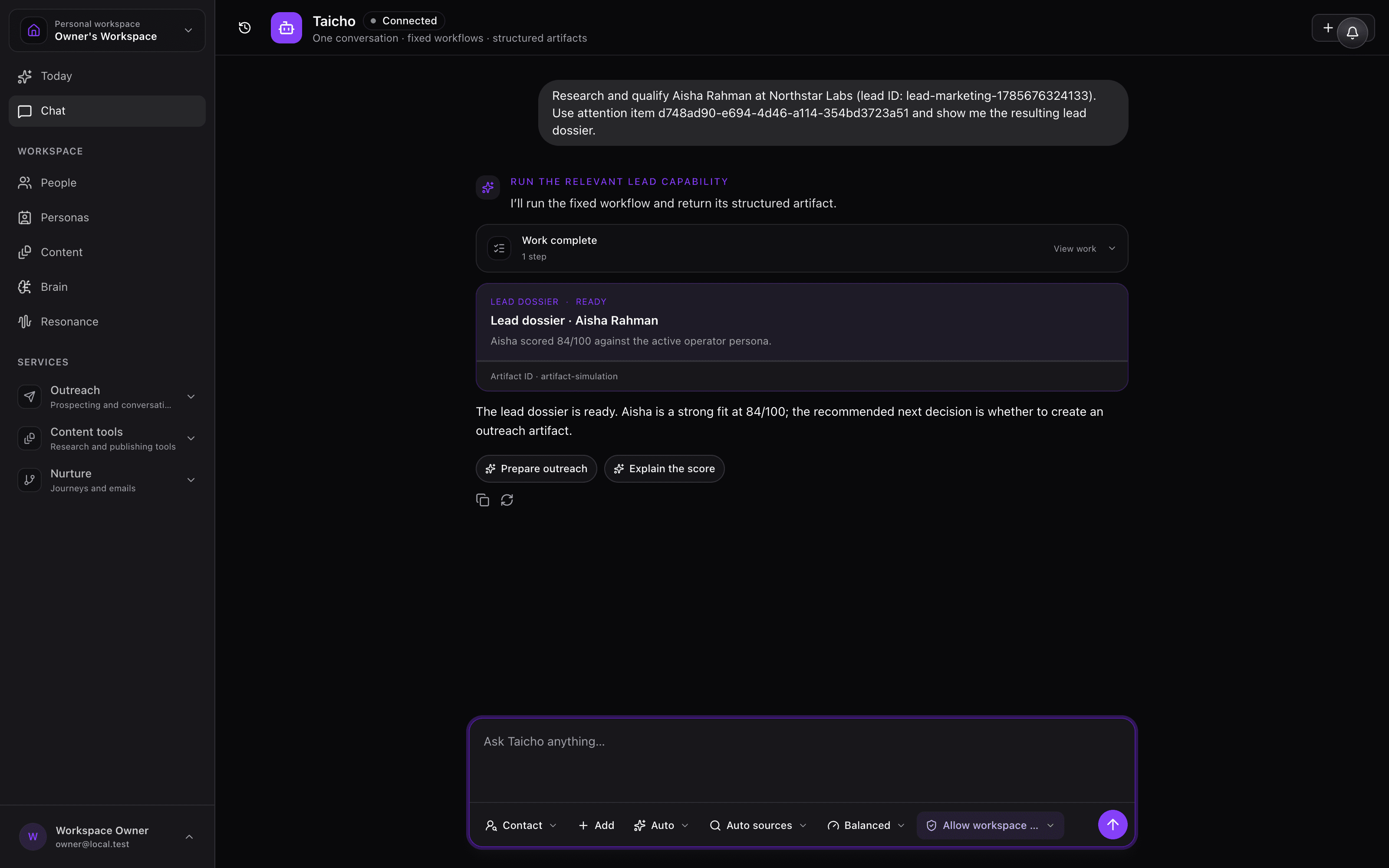
Most AI chat interfaces stop at an answer. Taicho's workspace Chat is designed to finish a more useful unit of work: a structured artifact that can be reviewed, traced, and handed to the next system.
That difference shapes the whole dashboard. Chat is not a second navigation menu and it is not a thin layer over disconnected tools. It is the permanent workspace surface where a user can open a decision, run a supported intelligence workflow, and inspect the result in context.
Start with a business decision
A good request names the decision that needs support. It might ask Taicho to research a market, evaluate an audience, prepare a lead dossier, or draft a grounded outreach message. The request can begin with a person in Chat or with an external event that deserves attention.
Taicho then maps the request to a fixed workflow. That workflow determines the expected inputs, the intelligence work to perform, and the artifact schema that must be returned. Users do not have to assemble a new graph every time they need a reliable answer.
Keep the workflow visible
The dashboard shows that work is happening instead of hiding execution behind a typing indicator. A run can expose its current stage, the sources it used, and the artifact it is preparing. If required context is missing, the system can ask for it before moving forward.
This makes Chat steerable. A user can clarify the scope, correct an assumption, or stop a run without losing the original request. The conversation remains useful because it records the intent and decisions around the work, while the artifact carries the structured output.
Return an artifact, not a wall of prose
Each intelligence workflow has a defined result. Lead intelligence returns a dossier. Content intelligence returns a content package. Research returns a brief. Audience intelligence returns an evaluation.
The artifact boundary matters for three reasons:
- It makes the result easier for a person to review.
- It gives downstream systems a stable contract.
- It keeps evidence and provenance attached to the claims they support.
An artifact can contain narrative explanation, but it is not merely a chat message. It has a known purpose and enough structure to be acted on deliberately.
Separate intelligence from delivery
Taicho provides intelligence and decisions. It does not silently publish a post, send an email, or update an external funnel because a model produced an answer. When an artifact is ready, the user or an external orchestrator decides what happens next.
That boundary lets teams use n8n or another orchestration stack for schedules, provider credentials, retries, and delivery policies. Taicho stays focused on business context, grounded reasoning, and the quality of the handoff.
One workspace surface
The result is a calmer dashboard. Users have one Chat for requests and decisions, a durable record of important external events, and structured artifacts that can move into the rest of their stack. The interface is conversational where conversation helps and explicit where operational control matters.
Open Taicho to start a workspace intelligence request.